Most people start by searching for a hearing test nearby and calling whichever clinic comes up first. The trouble is that “hearing test” can mean very different things. It might be a five-minute screening at a community event, or it might be a full evaluation with an audiologist, and the two answer different questions. A short phone call before you book will tell you which one you’re getting.
Start with who needs testing, and why
Before you compare clinics, be clear about the visit itself. Is it for you, or for a parent who keeps turning up the TV? For a toddler who doesn’t always respond to their name? Or do you already wear hearing aids and just need them checked? Each of those is a different appointment, and not every clinic offers all of them.
For a full assessment, look for an audiologist. Audiologists perform and interpret hearing tests, and part of the job is recognizing when a problem needs a physician’s opinion rather than more testing. The American Speech-Language-Hearing Association’s practice guidelines for audiologists describe both responsibilities.
Your insurer’s provider directory is a reasonable place to build a short list, along with your primary care office and friends who have been through it. Then pick up the phone. Directories go out of date, and a call is the quickest way to find out what a clinic actually does.
What to ask when you call
You don’t need a script, but these questions cover most of what matters:
- Do you test adults, children or both? If it’s for a child, what ages do you see?
- Is this a screening or a full diagnostic evaluation?
- Who does the testing, and who goes over the results with me?
- Are you in network with my plan, and do I need a referral?
- Is there parking and wheelchair access? Can you arrange an interpreter if I need one?
- If the results show a problem, what happens next?
Notice how the questions get answered, not just what the answers are. A clinic that explains things clearly on the phone tends to do the same in the exam room.
A screening is not an evaluation
A screening is a quick pass-or-refer check. Its job is to flag people who should have a closer look, and the American Speech-Language-Hearing Association’s guidance on adult hearing screening describes it in exactly those terms. A screening can’t tell you what kind of hearing loss you have, how much, or what to do about it.
A full evaluation can. Depending on your history, it may include:
- a conversation about what you’ve been noticing, and a look at your ear canal and eardrum
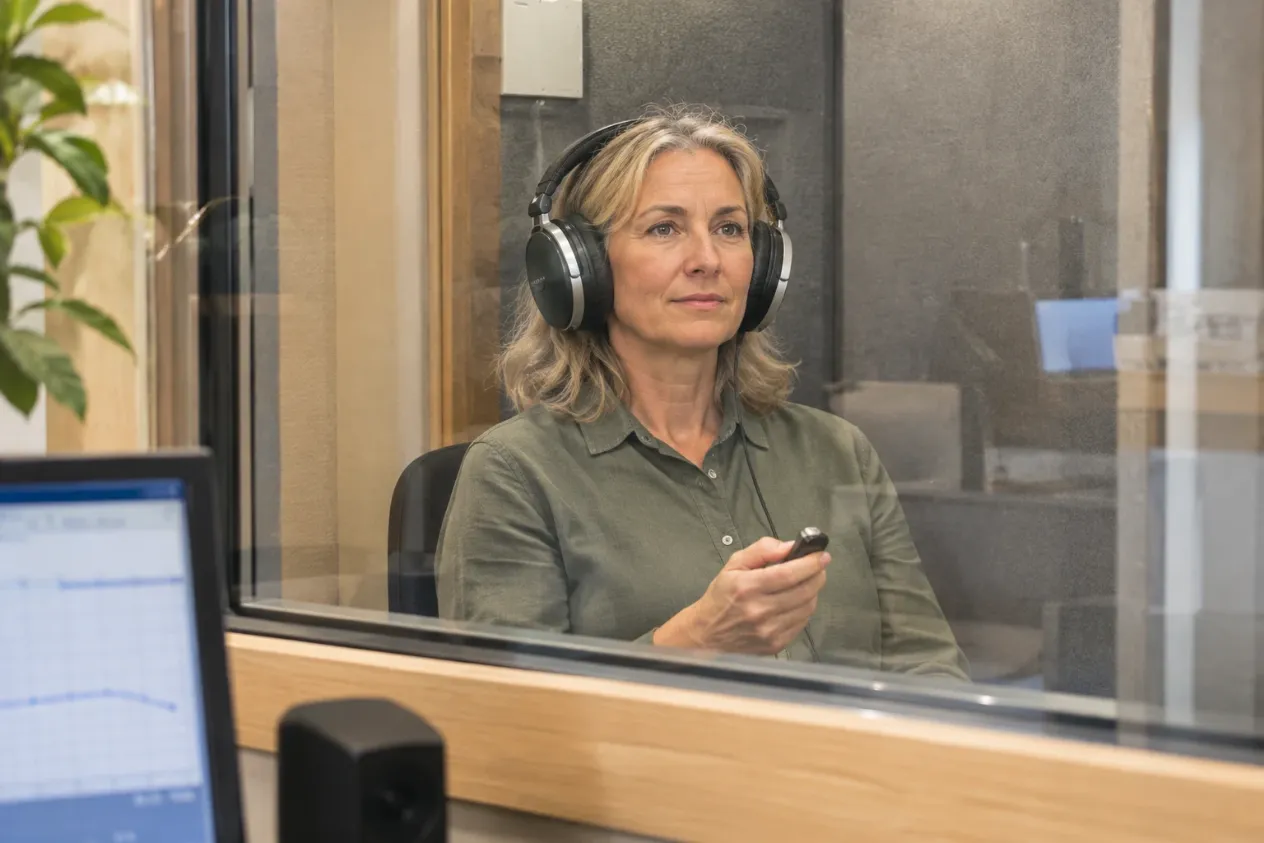
- pure-tone testing, which finds the softest tones you can hear at different pitches, through headphones and sometimes a small bone-conduction headset
- speech testing, which measures how well you hear and understand words
- tympanometry, a quick check of how your eardrum responds to changes in air pressure
Before you leave, you should understand your results and know whether you need follow-up, more testing or a referral. Ask for a copy of your audiogram, the chart that plots your results. If the symbols on it look like a foreign language, our guide to reading an audiogram walks through them.
Before you book an advertised hearing check
You may have seen hearing checks advertised at a pharmacy, a retail store or a health fair. A screening like that can be a fine first step, as long as you know what it is. Before you book, ask:
- What exactly is the service, and what does it include?
- Who performs it, and what are their credentials?
- If I need more testing, what will be charged, and by whom?
- Can I get my results without buying anything?
That last question matters most. Testing and buying hearing aids are separate decisions. The U.S. Food and Drug Administration notes that you can ask for your hearing evaluation records and buy hearing aids somewhere else. Your first appointment shouldn’t feel like a sales pitch.
Testing children
Children aren’t tested like small adults. A baby can’t raise a hand when they hear a beep, so audiologists use other methods. They watch how an infant reacts to sound, turn the test into a game for toddlers, or measure the inner ear’s and the brain’s responses to sound directly. Some of these tests can be done while a baby sleeps. The Centers for Disease Control and Prevention (CDC) describes each of them on its page about hearing screening in children.
When you call, ask whether the audiologist regularly sees children your child’s age and how to prepare. If a test can be done during sleep, ask whether to plan the visit around a nap or a feeding.
For newborns, the CDC’s benchmarks are known as 1-3-6: a hearing screening by 1 month of age, a full evaluation by 3 months if the baby doesn’t pass, and early intervention by 6 months if hearing loss is found. With older children, don’t wait for the next school screening if something seems off. Tell your child’s doctor and ask for a hearing test.
If it’s about hearing aids
A “hearing aid test” can mean three different things: an evaluation before you decide on hearing aids, help choosing and fitting a pair, or a check on the ones you already wear. Say which one you need when you book, so the clinic schedules the right visit.
A good fitting takes more than picking a device. The American Academy of Audiology describes hearing aids being programmed to a prescribed target with real-ear measurements, then fine-tuned over a few visits once you’ve worn them in everyday life. We explain how that check works in our article on real-ear measurement.
If you’re buying new hearing aids, get the details in writing before you commit: the total charge, which follow-up visits are included, the warranty, and the trial and return terms. If your current hearing aids came from another clinic, ask whether they service your brand and what to bring, such as the charger, the case and any paperwork.
Narrowing it down in South Florida
Finding the right kind of appointment matters more than distance, but nobody wants to cross Broward County for every follow-up either. Search with your city or ZIP code plus the service you need, for example “hearing evaluation Weston” or “pediatric audiologist Davie,” instead of relying on the map pin.
In Florida you can look up an audiologist’s license on the Department of Health’s license verification site. Search the clinician’s name, not just the practice name. Before you head out, confirm the address, what the appointment is for and who you’ll be seeing.
Insurance and Medicare
Call your insurer as well as the clinic. Ask whether the clinician is in network, whether you need a referral or prior authorization, and roughly what you’ll owe. Any estimate can change if the evaluation shows you need more testing.
With Original Medicare, Part B covers diagnostic hearing and balance exams when a doctor or other provider orders them. You can also see an audiologist once every 12 months without an order for hearing loss that has come on gradually. Original Medicare doesn’t cover hearing aids or the exams for fitting them. Medicare Advantage plans work differently, and many include a hearing benefit, so check yours.
What to bring
- your insurance card and any referral paperwork
- a list of your medications
- results from earlier hearing tests, if you have them
- your hearing aids and their charger or batteries, if you wear them
- a few notes on when you first noticed a change and where hearing is hardest, such as restaurants, phone calls or the car
It helps to bring someone you talk with every day, since they often notice things you don’t. Try to avoid loud noise, such as concerts, power tools or a noisy shift at work, for about 16 hours before the test. Recent noise can dull your hearing for a while and make the results less accurate.
When not to wait for a routine appointment
If your hearing drops suddenly, in one ear or both, don’t book a routine hearing test. See a doctor right away. The National Institute on Deafness and Other Communication Disorders (NIDCD) treats sudden hearing loss as a medical emergency and warns that delaying treatment can make it less effective. It can happen all at once or over a few days, sometimes with a feeling of fullness in the ear, dizziness or ringing. Many people put off care because they assume it’s earwax, allergies or a sinus problem. Don’t.
Booking a hearing test in Weston
At Movac Hearing, Dr. Viviana Martinez, Au.D., performs comprehensive hearing evaluations in English and Spanish and goes over the results with you at the same visit. Same-day hearing tests are available, but call ahead because the schedule can fill up. When you request an appointment, let us know who it’s for and what brings you in.
This article is general information, not a diagnosis. The right tests and next steps depend on your own hearing and history, which is what an evaluation is for.
Read the source guidance
Explore these primary references for more detail on the topics above.
- ASHA: Preferred Practice Patterns for the Profession of Audiology
- ASHA: Adult Hearing Screening
- CDC: Screening for Hearing Loss in Children
- FDA: How to Get Hearing Aids
- American Academy of Audiology: Hearing Aids
- Medicare.gov: Hearing and balance exams
- NIDCD: Sudden Deafness
- Florida Department of Health: License Verification
Related care and practical guides
Questions about booking a hearing test?
An online article cannot diagnose hearing loss or recommend a device for an individual.