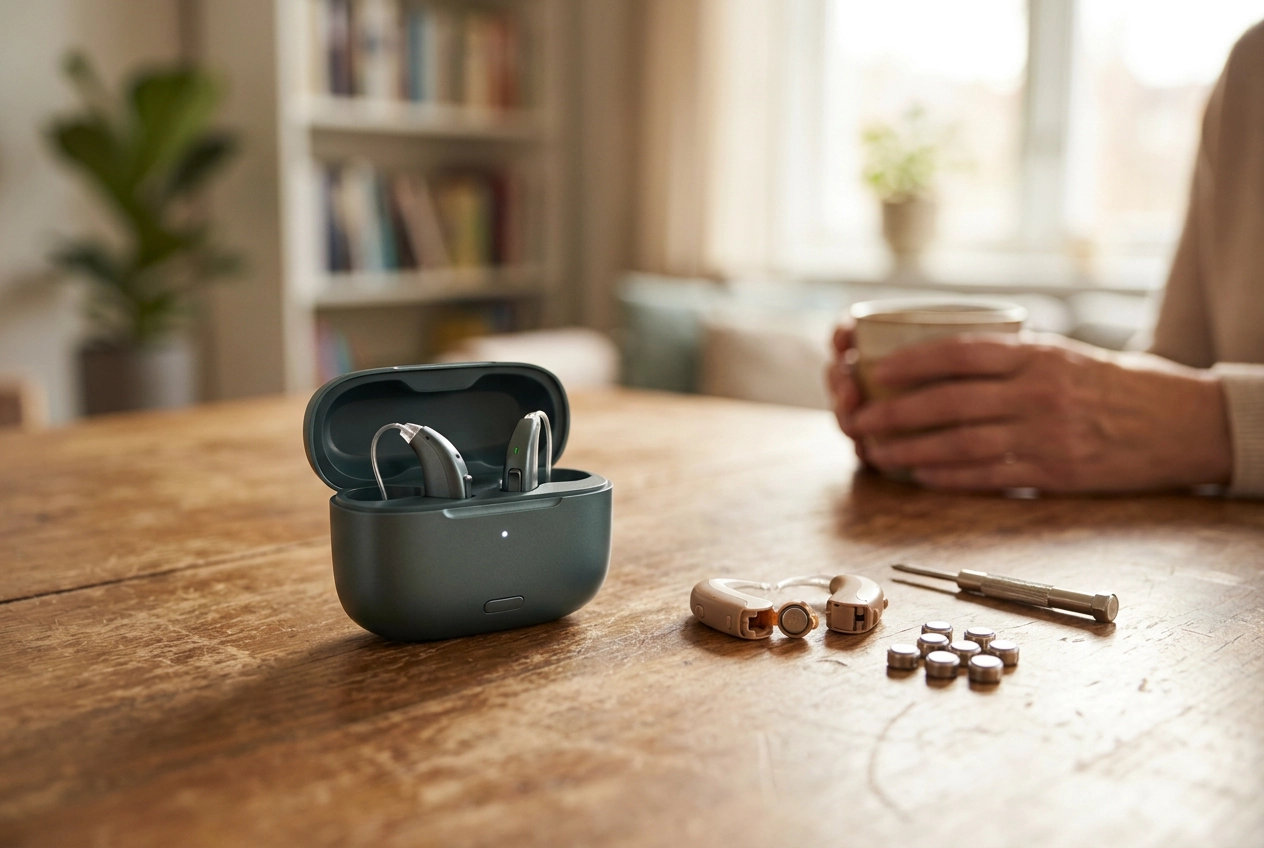
Hearing aids have become considerably better at surviving daily life, but they still need power and care. The choice between a rechargeable model and one that uses replaceable batteries is less about which is newer and more about how you live.
This article offers general education only. It is not a diagnosis or a treatment recommendation, and an individual hearing evaluation is needed before anyone can advise you personally on devices.
Two ways to power a hearing aid
Rechargeable hearing aids have a built-in battery. You set the devices in a charger, usually overnight, and start the day with a full charge. Many chargers also dry the devices while they charge, which is useful in humid climates. Some models offer a portable charging case for travel.
Hearing aids that use replaceable batteries take small button cells that you swap out yourself. The advantage is autonomy: a spare pack in a bag or glovebox means you are never waiting for a charger. The trade-off is handling small parts, and remembering to keep spares on hand.
There is also a practical similarity: both types eventually need service, and batteries of either kind are consumables rather than permanent.
What usually decides it
Dexterity and vision. If tiny parts are hard to manage, a charger can be much easier than changing cells.
Daily routine. An overnight charging habit suits people with a predictable schedule; replaceable batteries suit long days away from power.
Device style. Some very small custom hearing aids are built around one power option rather than the other.
Humidity and climate. Drying matters here in South Florida, whichever model you choose.
Daily care that makes a difference
Wax and moisture are the two most common reasons hearing aids underperform. Wipe the devices with a dry cloth or the tool your audiologist provides, keep the microphone ports and receiver openings clear, change wax filters as directed, and store the devices in a dry place rather than a bathroom. Keep them away from heat and never immerse a non-waterproof device. If sound drops, crackles, or cuts in and out, that is a reason to call rather than to turn the volume up.
When it may be a repair, not a battery
If a device will not hold a charge, will not power on with a fresh cell, whistles persistently, or sounds distorted, it may need service. Bring it in rather than trying to fix it yourself — internal components are not user-serviceable.
Prescription and over-the-counter hearing aids are not the same category
The FDA created a category of over-the-counter hearing aids for adults with perceived mild to moderate hearing loss, sold without a fitting appointment. Prescription hearing aids are selected, fitted, verified and adjusted by a licensed audiologist for your specific hearing loss, and they come with ongoing care. If you are unsure which path fits your situation, that is exactly what a hearing evaluation answers.
Questions worth asking
Which power option suits my routine and my hands?
What cleaning and drying routine do you recommend for this model?
How do I know when something needs service rather than a new battery?
Sources
National Institute on Deafness and Other Communication Disorders (NIDCD), Hearing Aids
U.S. Food and Drug Administration (FDA), consumer information on hearing aids and over-the-counter hearing aids
American Academy of Otolaryngology–Head and Neck Surgery (AAO-HNS), patient information on hearing loss and hearing aids
Movac Hearing provides comprehensive hearing evaluations and prescription hearing-aid selection, fitting, programming and follow-up in Weston, Florida, in English and Spanish. An individual evaluation is the only way to know what your ears need; please call to schedule one.
Need advice for your own hearing?
An online article cannot diagnose hearing loss or recommend a device for an individual.
Prefer to talk first? Call (754) 290-3270.